
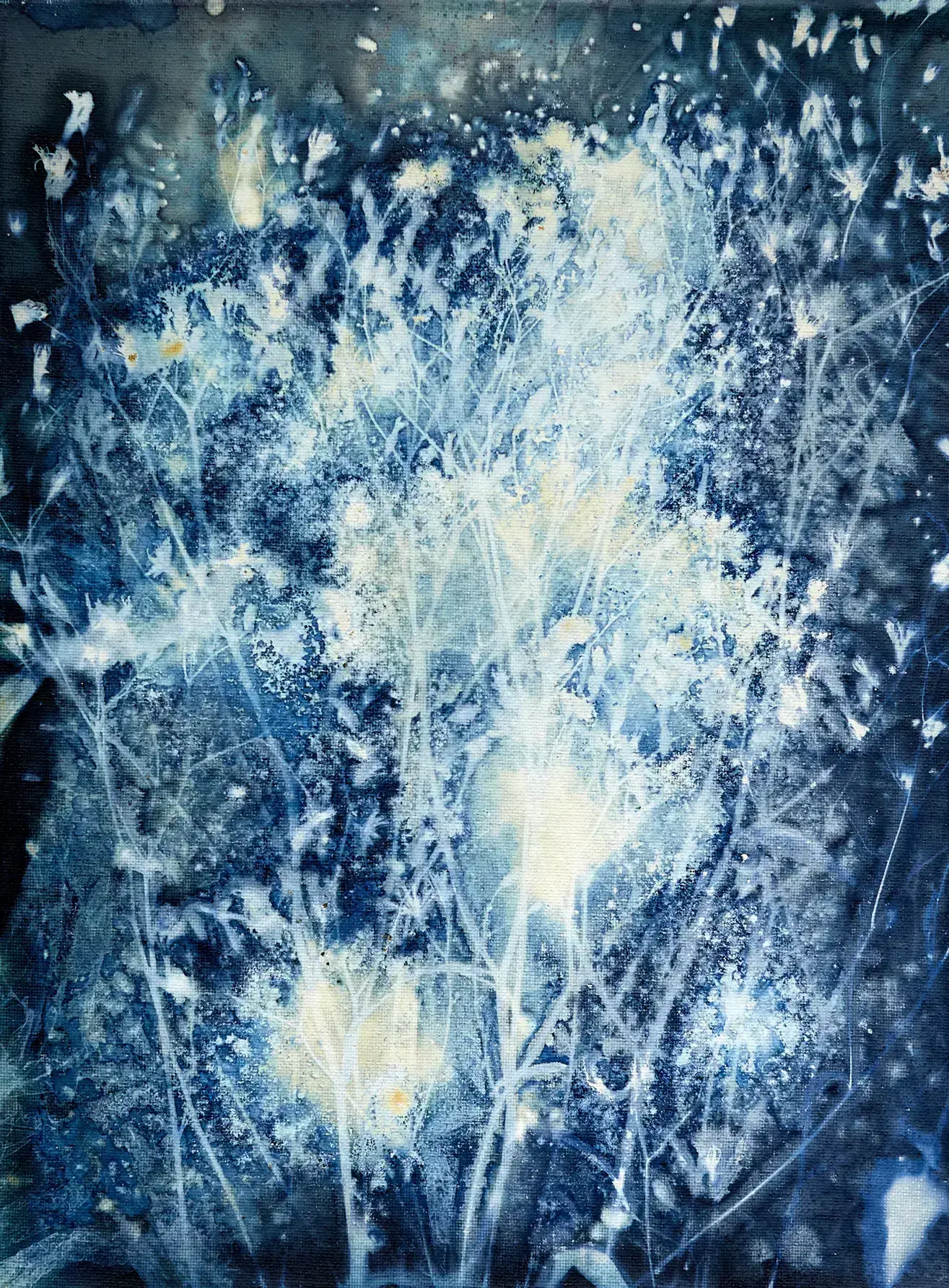
Second Nature
A discourse on nature and creation
Working with cyanotype—a process dating back to photography’s pioneering experiments—George Popovici surprises us once again.
As in many of his photographic series, including his recent solo exhibition Shaped by Love, presented within Romanian Creative Week 2025, he chooses a minimalist vocabulary to articulate his vision of a group of contemporary philosophical theories concerned with the concept of “second nature.”
Conceptually, the technique transforms both the artistic act and the chosen subject—the vegetal world. The repetition of gestures—preparing the solutions, coating the paper, selecting and arranging the objects, estimating the exposure time—leads to a practical, intuitive knowledge that transcends technical rules and becomes creative instinct. Mastery of the process thus becomes the artist’s second nature. Yet the concept extends further: the flowers, leaves and other botanical elements speak of transformed nature—of selection, manipulation, documentation, reflection and social critique.
Cyanotype, often described as “photography without a camera,” involves coating a surface with a solution of iron salts, arranging the elements of the composition on the sensitised surface and exposing it to ultraviolet light. The result is an intensely Prussian-blue image in which forms are metamorphosed into a combination of delicate details and striking contrasts.
George Popovici’s cyanotype series offers contemporary quotations from the work of Anna Atkins, the nineteenth-century British artist who pioneered the use of cyanotype to illustrate botanical specimens. She published the first photographically illustrated book, Photographs of British Algae: Cyanotype Impressions (1843), transforming a scientific endeavour into artistic reflection through the agency of second nature.
The concept, which describes a naturalness specific to human experience and shaped by habit, becomes, in Popovici’s vision, a representation of natural environments altered by humankind. His works suggest coexistence—and, at times, symbiosis—between what is natural, such as leaves, flowers and branches, and what is artificial or produced through human intervention: chemistry, technique and the rearrangement of elements according to an aesthetic foreign to nature itself.
The artist’s compositions examine how nature survives and adapts within environments dominated or transformed by human intervention. They are the result of a negotiation whose final imprint is unmistakably artificial. The element of unpredictability inherent in cyanotype adds subtle nuances to the idea of an accidental ecosystem, emerging from an affective analysis of the relationship between the “authentic” and the “created”—the latter, in many instances, becoming synonymous with the “degraded.”
Second nature is more than an artistic theme: it is a lens through which we may understand how human beings influence the environment, as well as how the environment, in turn, shapes our perception and visual culture in the age of the Anthropocene. Through his cyanotype series, George Popovici succeeds, with elegance and sensitivity, in conveying a profound artistic message about the beauty and persistence of nature.